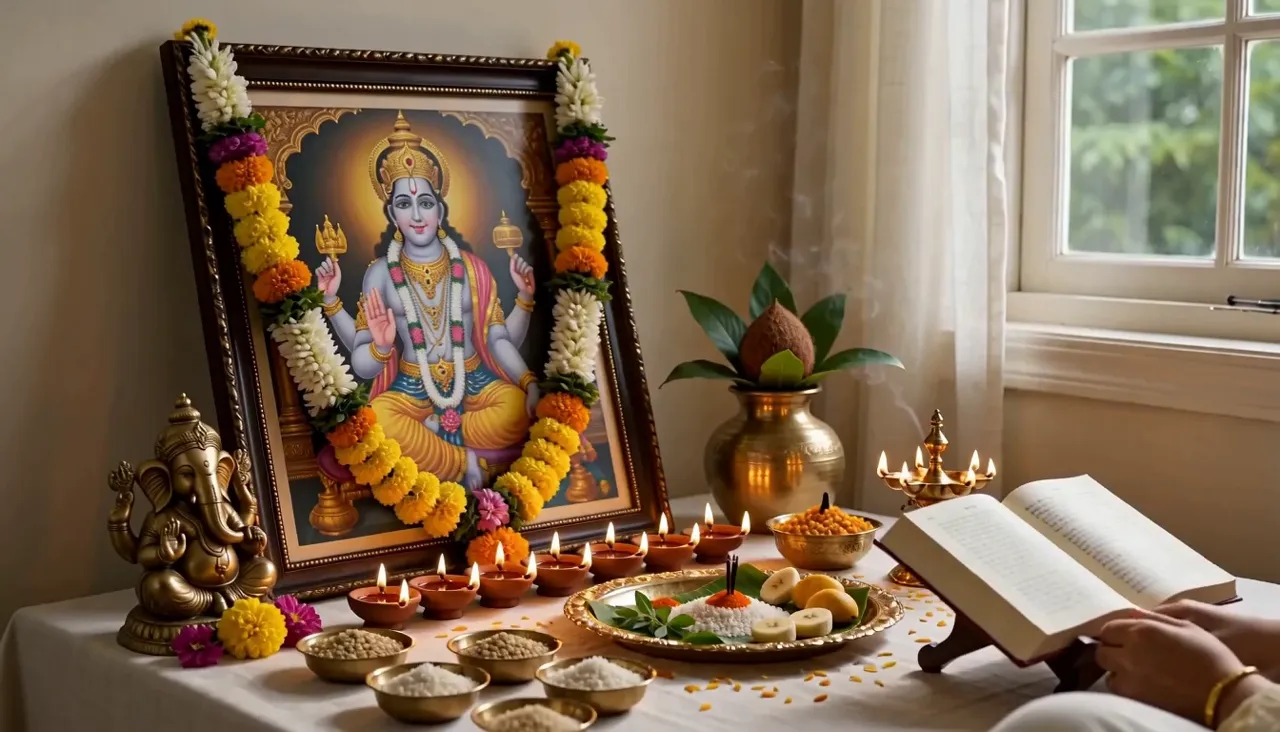
Satyanarayan Puja
A family prayer of gratitude, truth and devotion.
Satyanarayan Puja is devotional worship of Lord Satyanarayan, a form of Lord Vishnu, with the traditional Katha at its centre. Manishbhai helps prepare the puja, the reading and the practical arrangements around your family tradition, and explains what is happening so everyone present can take part.
Family tradition respected
The sequence and customs your household follows are discussed with you rather than assumed.
Satyanarayan Katha included
The traditional reading sits at the centre of the observance, with explanation where that helps.
Help organising your puja samagri
The materials needed for the agreed puja can be arranged. What is supplied and any cost are confirmed clearly before the booking.
Explained in plain English
Sanskrit and the mantras are retained as appropriate, with the meaning explained for younger relatives and guests.
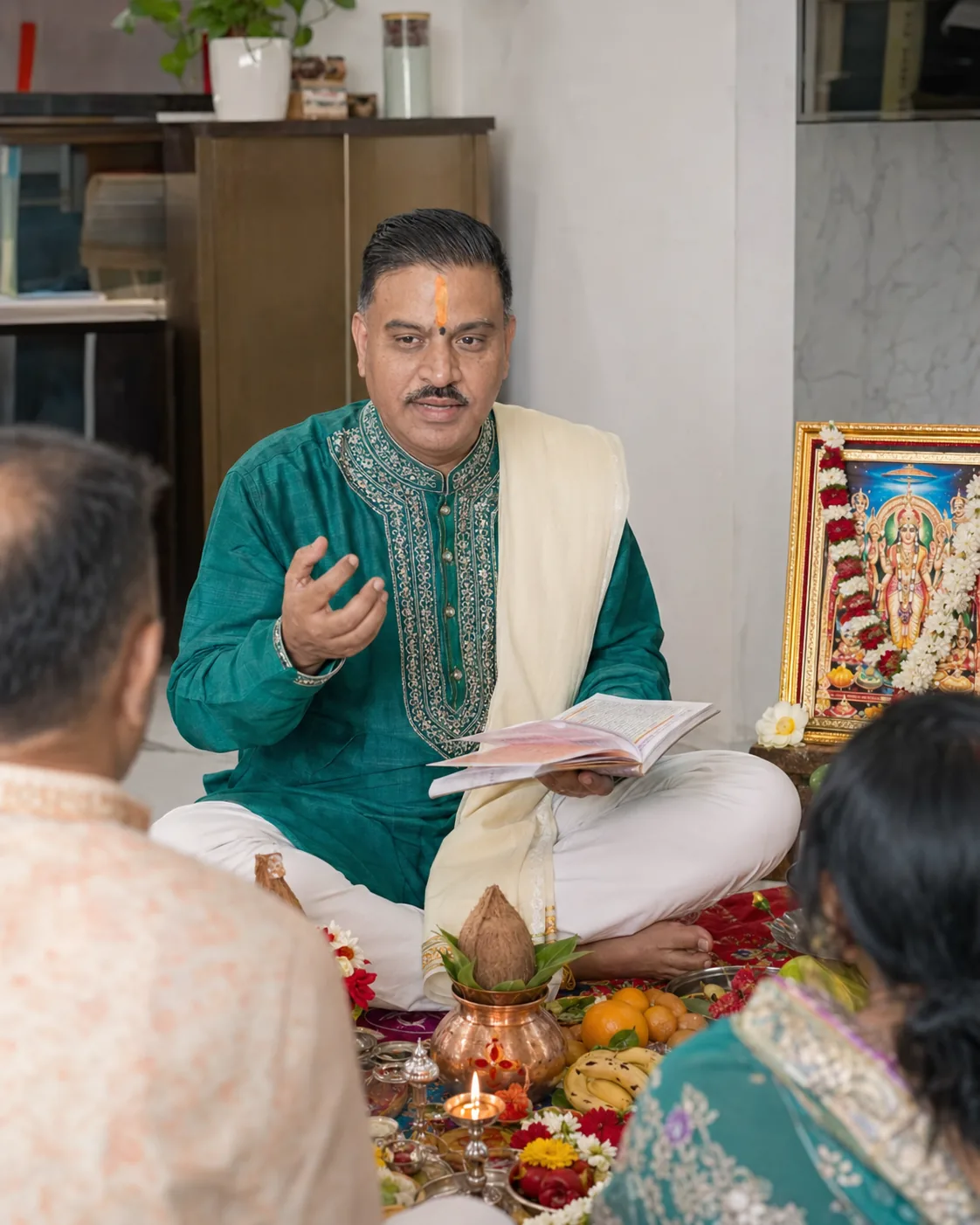
A puja shared together
More meaningful when the family can follow it.
A Satyanarayan Puja is not something the family should simply sit and watch. Each stage is introduced briefly, so everyone knows what is happening, when they take part and what the offerings are for.
The Katha is central to the observance. Where helpful, its meaning can be drawn out in simple English so family members understand the themes as well as hear the traditional reading.
What it means
What is Satyanarayan Puja?
Devotional worship of Lord Satyanarayan, a form of Lord Vishnu, with the traditional Katha as an important part of the observance.
Devotion and gratitude
Worship offered to Lord Satyanarayan through prayer, mantra and offerings — an act of respect, gratitude and devotion. Families arrange it to give thanks, to mark a vow or vrata, to begin something new, or as a devotional observance in keeping with what their household follows. Sincerity and attention matter more than scale.
The Satyanarayan Katha
The traditional narrative read during the observance. Its themes are often described as truthfulness, devotion, keeping one’s word and remembering the sacred within ordinary family life. It is read in keeping with your family’s practice rather than to a single fixed interpretation.
Regional, family and sampradaya practices differ — including the sequence, any fasting observed, the day chosen and what is prepared as prasad. Nothing here is presented as a guarantee of any outcome; the purpose is devotional.
When families ask for it
Occasions families often mark
These are the reasons families most often get in touch. They are neither required nor a complete list.
A new home or housewarming
Often held as a family settles into a new house or flat.
A wedding or family celebration
Some families include it around a marriage or another happy gathering.
A naming or family milestone
Arranged alongside a child’s milestone or another step in family life.
Thanksgiving after a moment that mattered
Some families choose the puja to give thanks after an important family moment, such as a recovery, an achievement or a new beginning.
A vow or vrata
Where a family observes a vrata, the puja can be prepared in keeping with it.
Regular family worship
Some households observe it periodically, or on a day their tradition treats as auspicious.
What usually happens
The shape of the puja
The exact sequence depends on the tradition your family follows. This is the shape families commonly ask for; not every household observes every part.
Sankalp
The family quietly states the intention — what is being marked, and why.
Opening prayers & kalash
Prayers to Lord Ganesha and the setting of the kalash, where these are followed.
Worship of Lord Satyanarayan
Offerings and mantras dedicated to Lord Satyanarayan, a form of Lord Vishnu.
Satyanarayan Katha
The traditional narrative is read, with key passages summarised in English where a family would like that.
Aarti & prasad
The puja commonly closes with aarti, and prasad is shared among those present. What is prepared varies between families.
How it works
Four simple steps, starting from wherever you are
- 01
Tell us what you are marking
What the occasion is, roughly how many will be present, and the date you have in mind.
- 02
Family custom & setting discussed
What your household observes, and whether the puja is best held at home or in another suitable setting.
- 03
Timing & samagri confirmed
The form agreed, a realistic length so guests can be told, and the materials needed.
- 04
Puja & Katha conducted
The rites and the reading are led at a pace everyone present can follow, explained where that helps.
The materials needed for the agreed puja can be arranged. What is supplied and any cost are confirmed clearly before the booking — see puja samagri.
Questions
Satyanarayan Puja
In their own words
After a Satyanarayan Puja at home
Shared with each family’s permission, in their own words. No ratings are collected, so none are shown.
Read more family experiences“A big thank you for the Satyanarayan Puja. It was conducted beautifully, without being rushed, and everyone could follow and understand what was happening. The whole family really enjoyed it.”
Rajubhai ThankiSatyanarayan Puja
Continue reading
- Griha PraveshEntering a new home with prayer.
- Pujas & SanskarasHousehold pujas and life-stage rites, explained.
- Preparing Your Home for a PujaWhat to have ready before the day.
- Puja SamagriMaterials for the agreed puja can be arranged and confirmed with you in advance.
- All Pujas, Ceremonies & SanskarasThe full directory of ceremonies, grouped into six categories.
- Sankalp — stating the intentionWhy every puja begins with it, and what is said.
- Prasad, explainedWhat it is, why it is shared, and how to receive it.
Planning a Satyanarayan Puja?
Tell us what your family is marking.
You do not need to know the full ritual details. Tell Manishbhai what the occasion is, and the right next step, your family custom and the practical preparation can all be discussed with you.
Discuss Your Satyanarayan Puja