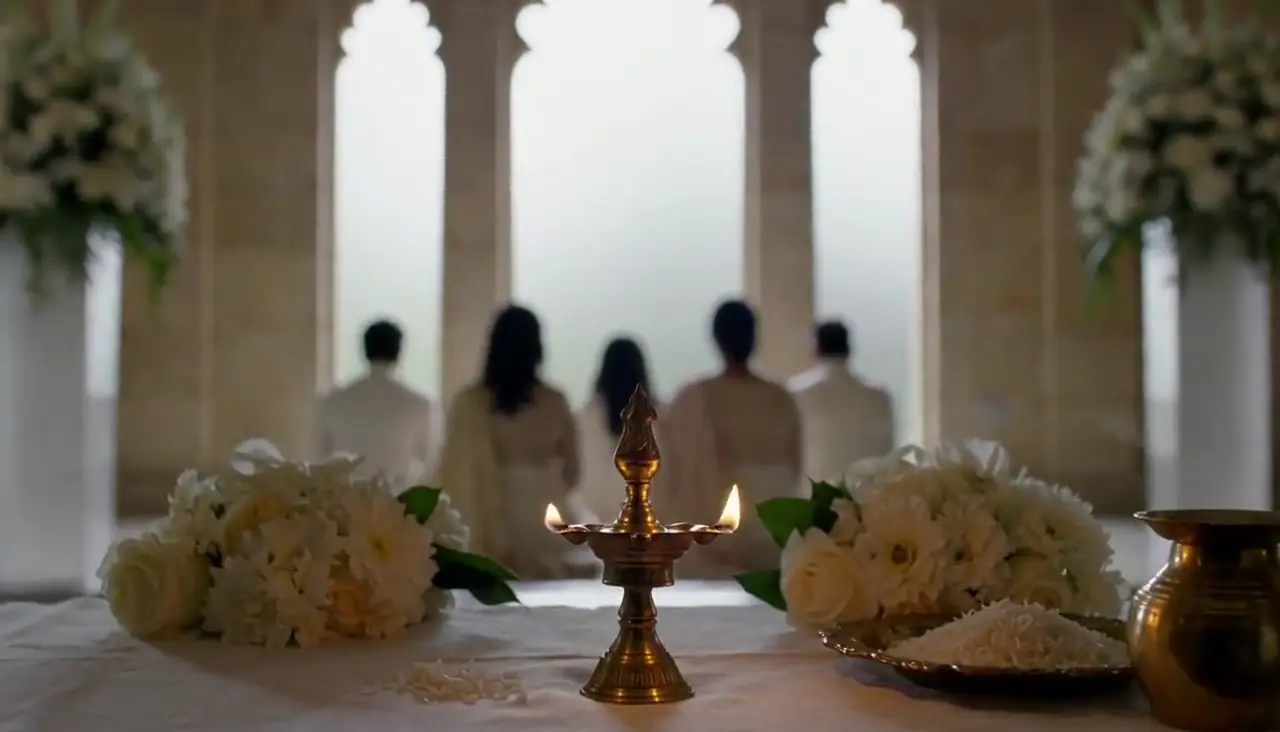
Immediate family guidance
A telephone conversation to help you understand what needs to happen first, and prayers at home where the family wishes them.
Funeral & Remembrance
Shastri Ji leads Hindu funeral rites (Antim Sanskar) across the UK, working alongside your family’s chosen funeral director and explaining each step in Gujarati, Hindi or English. You can call at any time, day or night, even before anything is arranged.
Last reviewed
Created with AI from ShastriJi’s own portrait and voice, with his approval.
A personal word from ShastriJi
If you have lost someone, we are very sorry. Shastri Ji explains here how he supports families through the funeral rites and the days that follow — at your pace, with nothing to decide before you call.
If you have lost someone, we are very sorry. You can call at any time, day or night, or write on WhatsApp even if the arrangements are not yet complete; share only what you know.
Leave your name and number. Shastri Ji or a member of the family team will call you back as soon as possible.
Your details are used only to respond to this enquiry and to discuss your ceremony.
A short conversation is often enough to make the next few days feel possible. Nothing needs to be decided before you call.
Prayers at home before the funeral and the rites at the crematorium, arranged around the confirmed crematorium time and any funeral-director arrangements.
Hindu last rites vary between families, regions and traditions. What your family observes is asked about rather than assumed.
Practical help understanding the immersion or scattering of ashes, and the options available here in the United Kingdom.
Practical steps
General guidance only. Hospitals, hospices and local register offices each explain their own arrangements, and nothing here needs to be done in a particular order before you call.
If the death was expected and happened at home, call the GP surgery, or NHS 111 when it is closed. If it was sudden or unexpected, call 999. In a hospital, hospice or care home, the staff will guide you.
A short call to Shastri Ji lets the prayers at home begin to be planned, and answers what your family should or should not do in the first hours. Nothing needs to be arranged before you call.
The funeral director looks after the practical arrangements: care of your loved one, the coffin, transport and booking the crematorium. Choose whichever firm suits your family.
A doctor issues the medical certificate of cause of death. In England and Wales it is reviewed by a medical examiner, unless the death is referred to a coroner. Mentioning early that your family hopes to hold the cremation without unnecessary delay can help.
The death is registered at a register office, normally within 5 days in England and Wales and within 8 days in Scotland, unless a coroner is involved. The registrar provides the paperwork the funeral director needs.
Shastri Ji guides the home rites your family observes, such as prayers at the bedside or before the funeral, and explains what will happen next at a pace that suits you.
The full step-by-step guide is in what to do when a Hindu loved one dies in the UK.
A few helpful details
Only share what is known. The arrangements do not need to be complete before you call.
Please do not send medical records or identity documents through an enquiry.
Attendance, timings and the arrangements are discussed personally before a ceremony is confirmed.

Where to begin
If you have lost someone, we are very sorry. There is no need to have decided anything before you call. A short conversation can help make the next steps clearer.
Once the crematorium time is known — whether arranged through a funeral director or directly — the prayers your family observes can be planned around it at home, at the crematorium and afterwards, with the sequence explained beforehand.
Where your family is already working with a funeral director, we can speak with them directly about timings, what the rites require at the crematorium and how long to allow, so you are not left relaying instructions between two parties. If a funeral director has not yet been appointed, that is fine too — the ceremony side can be discussed first.
Your funeral director handles practical funeral arrangements; Shastri Ji guides the religious rites. The two can be coordinated with your family’s agreement, respecting the crematorium’s time allocation and rules.
Families searching for a Hindu funeral director are often looking for two people: a funeral director for the practical arrangements, and a priest for the rites. Shastri Ji is the priest, not a funeral director. He works alongside whichever funeral director your family chooses, including firms that regularly arrange Hindu and Indian funeral services, and coordinates timings with them for the crematorium service. Questions worth asking the funeral director include: whether the deceased can be brought home or viewed for Antim Darshan before the funeral; how much time the crematorium chapel slot allows for prayers; whether the family may witness the committal; and how and when the ashes will be returned.
You can ask your funeral director to call Shastri Ji directly on +44 (0) 7717 154 215. If you are still looking for a Hindu or Indian funeral director, he can recommend trusted funeral directors through the partner network.
Funeral directors are welcome to contact Shastri Ji directly about a family they are supporting, or about working together: funeral directors: partner with us.
For the practical steps, readwhat to do when a Hindu loved one dies in the UKanda Hindu funeral at a UK crematorium.
We also work with suitable locations and providers across the United Kingdom for Asthi Visarjan — the respectful immersion or scattering of ashes — subject to local access, environmental, safety and operator requirements.
Telephone is quickest: +44 (0) 7717 154 215.
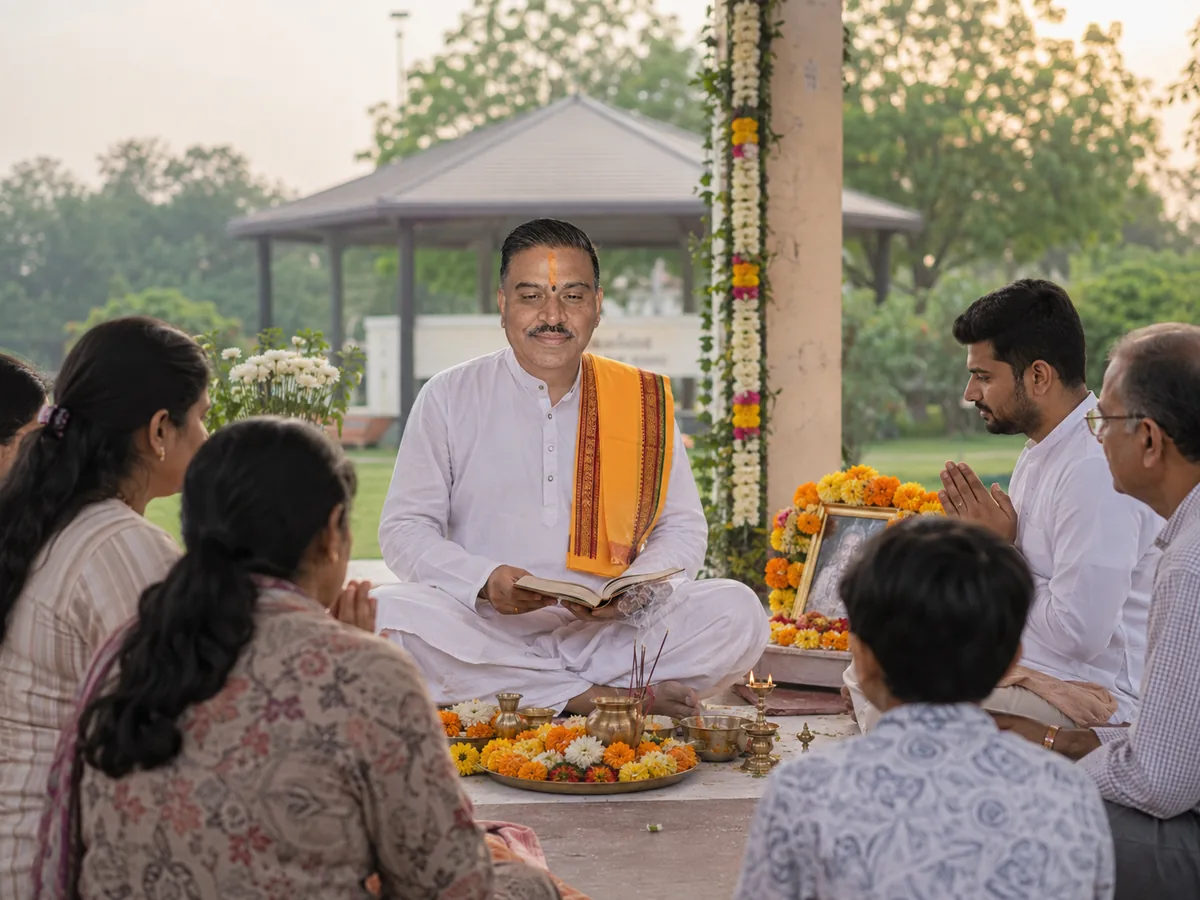
Antim Sanskar means the final rites. In the UK, many Hindu families choose cremation, with prayers at home or at the crematorium according to their tradition. Your funeral director or crematorium guides the practical arrangements; the religious sequence is discussed separately with your family.
Where observed, relatives may offer a final farewell, flowers and prayers before the cremation. Mantras, readings and family participation are planned around the agreed chapel time. No single sequence applies to every Hindu household, and brief English explanations can be offered gently.
Afterwards, some families hold further prayers or a remembrance gathering. Shraddha refers to remembrance rites; Asthi Visarjan is the immersion of cremated remains. Whether, when and how these are observed depends on family custom and practical circumstances, with local rules checked for ashes arrangements.
Most Hindu funerals in Britain end at a crematorium, which has a time slot and rules of its own. Because the chapel slot is usually short, many families hold most of the prayers beforehand, at home or at the funeral director’s chapel, where there is no clock running.
In the chapel, the priest recites the essential mantras and quietly guides each step, explaining in plain English where that helps. The chief mourner, traditionally the eldest son though many families now choose another close relative, makes the final offerings, and the committal follows. Many families wish to witness the coffin entering the cremator; many crematoria allow this on request, but it must be arranged in advance.
Whether lamps, incense or rice are allowed, how many people the chapel holds and the length of the slot vary between crematoria, so your funeral director can ask beforehand. Where open flame is not permitted, the prayers are adapted to what the crematorium allows. The ashes are usually ready to collect a few days later.
Read the full guide to a Hindu funeral at a UK crematorium.
No prices are published. The priest’s fee is on application, and Shastri Ji will always explain it in advance, before anything is confirmed. It depends on:
The funeral director’s and crematorium’s charges are separate and are set by them. If ceremony materials (samagri) are needed, these can be arranged at an additional cost and discussed at the same time.
Many families keep further rites in the days, months and years afterwards. These can be discussed whenever your family is ready.
How we can help
Families observe these rites differently, and that is as it should be. What follows is offered as guidance, not a fixed order of service.
A telephone conversation to help you understand what needs to happen first, and prayers at home where the family wishes them.
The prayers appropriate to your family’s tradition, conducted calmly and explained gently to those present who may be unfamiliar with them.
A prayer meeting at home or at a venue, with readings, bhajans or a short address where the family would like them.
The observances some families hold in the days after the cremation. Practices differ, so the sequence is agreed with you rather than fixed in advance.
Remembrance prayers where your family observes them, whether the loss was recent or many years ago.
Guidance on immersing or scattering ashes, including UK water options, and prayers at the riverside or on board where that is arranged.
Ashes scattering & water remembrance
Asthi Visarjan is the immersion of cremated remains in flowing water. Many families take ashes to India; others choose a UK river or coastal setting, which can be done with the same care.
The Port of London Authority states that no permission from the Authority is needed to scatter ashes into the tidal Thames. It advises choosing a safe, quiet spot, not scattering from bridges, and putting no containers or plastic into the water. Access may still need the landowner’s permission.
Leicester City Council provides a designated ashes-scattering site on the River Soar, immediately behind the National Space Centre.
Other local rivers and coastal locations may be suitable, considered case by case. Access, environmental and safety rules differ by location, so the relevant authority or landowner is asked before anything is arranged.
A private charter can be considered where a family wants privacy, subject to operator availability, passenger and safety rules, and the requirements of the waterway.
Prayers and mantras are offered on the bank or on board, and the ashes are scattered or immersed respectfully. Loose natural petals are sometimes used, though anything placed in the water depends on local environmental rules and, where a boat is used, the operator’s terms. Please choose a safe, quiet place away from anglers, swimmers, moorings and water abstraction points, and leave no containers, plastic or wreaths in the water.
The rites themselves are guided by Shastri Ji. Anything practical around them — a boat operator, a river or coastal location, or travel arrangements if ashes are being taken to India — is arranged by the family or by an independent provider, and we are glad to talk through what to ask them. Where a location is being considered, we can discuss whether it is suitable for the prayers your family wishes to observe.
Read more about Asthi Visarjan support in the UK.
Funeral & remembrance support
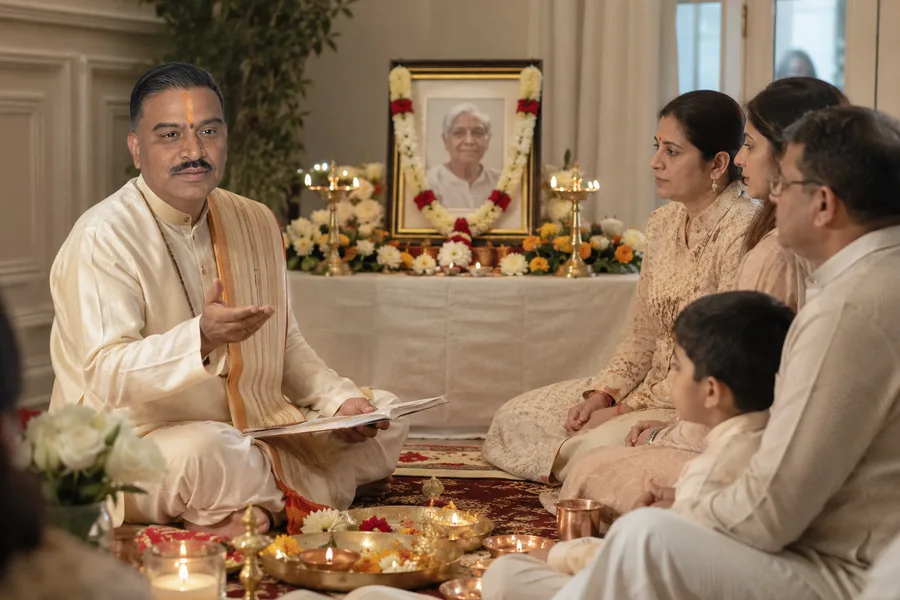
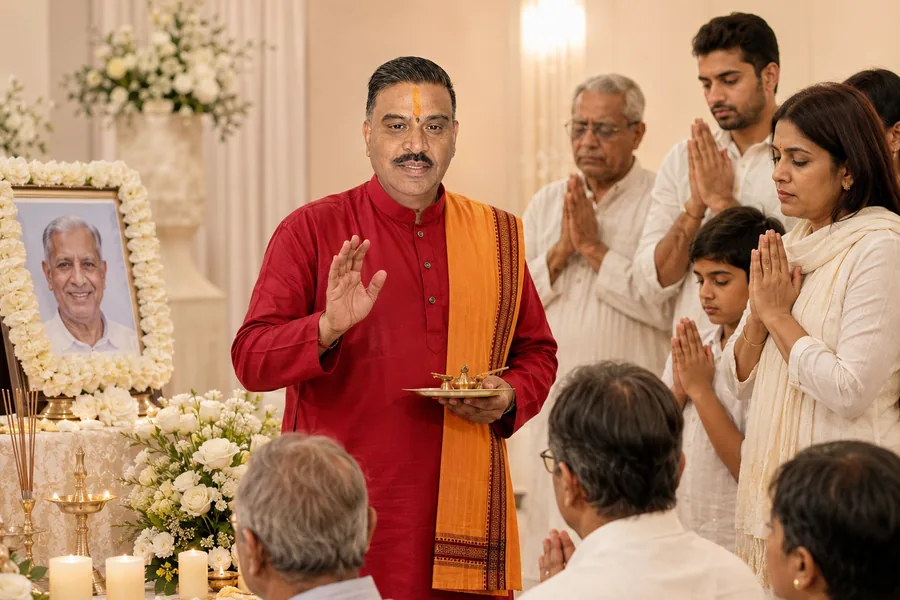
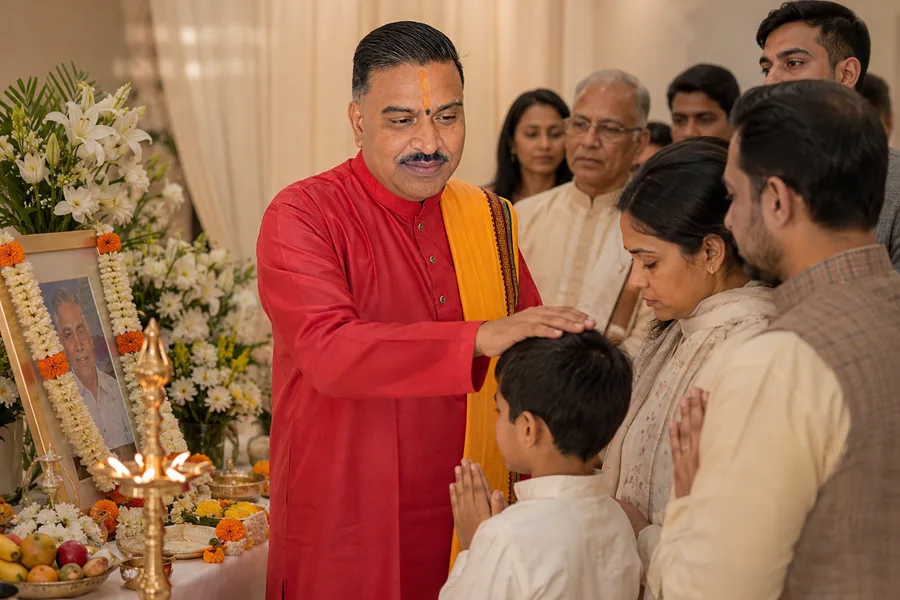
Illustrative editorial photography. No family, venue, location, date or occasion is implied.
How it works
Telephone, or send a short message. It helps to know where you are in the process, but nothing needs to be arranged first.
What your family observes, who is travelling, and what needs to happen in the next day or two.
Crematorium, home or venue prayers, remembrance dates and, where wanted, ashes arrangements, agreed around the confirmed crematorium time and any funeral-director arrangements.
The rites conducted with dignity, with clear guidance afterwards on any observances your family keeps.
These areas have their own funeral pages, with the towns covered and local questions answered:
Across the UK
Families are supported across the United Kingdom. These are the areas with their own local pages; they are service areas, not office locations, and travel is agreed for each family.
Elsewhere in the UK? Please call with your town or postcode, or see Hindu priest service areas.
Questions
Shared quietly
Shared with the family’s permission, in their own words. Nothing here is a rating or a review score.
More family experiences“At a very difficult time for our family, your calm manner, compassion and guidance meant a great deal to us. You explained what needed to happen with sensitivity and gave us the space to say goodbye properly and with dignity. We will always remember the kindness and respect you showed our family during those days. Our heartfelt thanks.”
Funeral & Remembrance
After losing a loved one, one family was grieving while also trying to understand the Hindu rites that needed to be performed.
Continue reading
Need guidance now?
Telephone if it is urgent, or send a short message. Nothing is confirmed until your family is comfortable with the arrangements.
Prefer to write? Message on WhatsApp.
When a loved one has died, call Shastri Ji at any time, day or night.