For the wedding team
Working Around a Hindu Wedding Ceremony
A practical guide for wedding planners, venues, photographers and videographers. Written to help you plan confidently around the ceremony — and to protect both its sanctity and the moments the couple wants captured.
A Hindu wedding ceremony has its own rhythm, its own significant moments and its own practical requirements. Most of what makes the day run smoothly is decided long before it — which rites the family is including, where the mandap sits, whether a sacred fire is permitted, and how long the ceremony realistically needs.
Hindu families differ considerably by region, community and household, so nothing here is a universal rule. Treat it as a set of questions worth asking, and confirm the specifics with the couple and the officiating priest for the wedding you are working on.
Last reviewed:
How a wedding is prepared
Certainty first, then understanding, then coordination. The ceremony is the calm end of the process, not the whole of it.
Date and availability check
We confirm whether the date works before anything else is planned around it.
Legal position, made clear
How the religious ceremony sits alongside a civil marriage in England and Wales.
Ceremony design
An agreed order of service, timings and the parts you want explained aloud.
The ceremony itself
Led calmly, at a pace guests can follow, with the meaning spoken as it happens.
Before the day
What the ceremony team should confirm early
Eight items worth confirming before they become day-of questions.
Step 1: Which rites the family is including
Two Hindu weddings can contain quite different sequences. The ceremony content, not a general template, determines the running order and the realistic window.
Step 2: The agreed ceremony window
A window is agreed with the couple once the rites are settled. It is worth having that figure before the timeline is circulated, rather than after.
Step 3: Whether a sacred fire is planned
Whether an open flame is possible is determined by the venue and the rules that apply to it. Confirm the venue’s position early, because the ceremony is adapted around the answer.
Step 4: Mandap position and orientation
The mandap — the canopy under which the marriage takes place — needs a suitable position, with seating and sight-lines for both families considered together.
Step 5: Entrances and processions
The groom’s arrival and the bride’s entrance often involve larger groups, music and movement through the venue. Route, timing and space are worth walking through beforehand.
Step 6: Microphones and sound
Mantras are recited throughout. If the family wants guests to hear the ceremony and any English explanation, sound needs planning rather than improvising.
Step 7: Access for ceremony materials
Samagri — the ritual materials — arrives, is laid out and is cleared away. Where and when that happens affects the room turnaround.
Step 8: Who at the venue signs off the plan
Knowing the person who actually approves the ceremony arrangement helps avoid unnecessary back-and-forth late in planning.
The ceremony
Key moments to understand
Names, order and inclusion vary by family and region. This is the general shape rather than a fixed running order.
- 01
Opening prayers
Many ceremonies begin with prayers to Lord Ganesha. It is short, and it marks the point at which the ceremony has begun.
- 02
Welcoming and the meeting of families
The groom’s party is received and relatives are formally introduced. Warm and busy, with a good deal of movement; the form this takes varies between families.
- 03
The bride’s entrance
A still moment for both families. Positions agreed beforehand help here.
- 04
Exchange of garlands
A light-hearted stage in many ceremonies, and usually brief.
- 05
Giving of the bride and joining of hands
A quiet, significant passage. Movement close to the mandap is best kept to a minimum.
- 06
The sacred fire and the circling
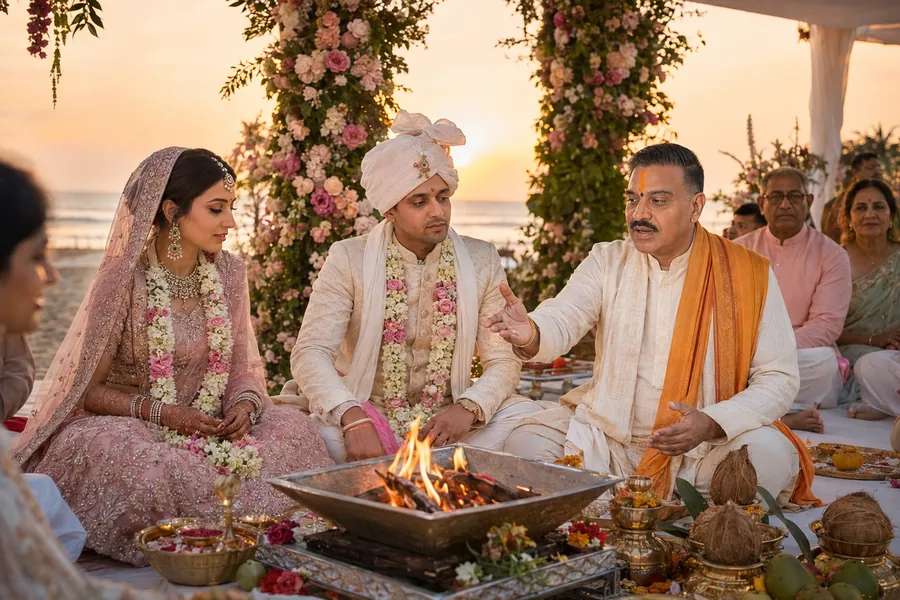
Offerings are made into the fire and the couple circle it. The number of circuits varies by family tradition.
- 07
The seven steps
The Saptapadi. Central to the marriage, and best left undisturbed.
- 08
Marks of marriage and blessings
The ceremony closes with the customary marks of marriage and blessings from elders. In some families guests are invited forward at this point.
For a fuller plain-English walkthrough, see what happens at a Hindu wedding, stage by stage.
Practicalities
Working around the sacred fire
What is the fire, and why does it matter?
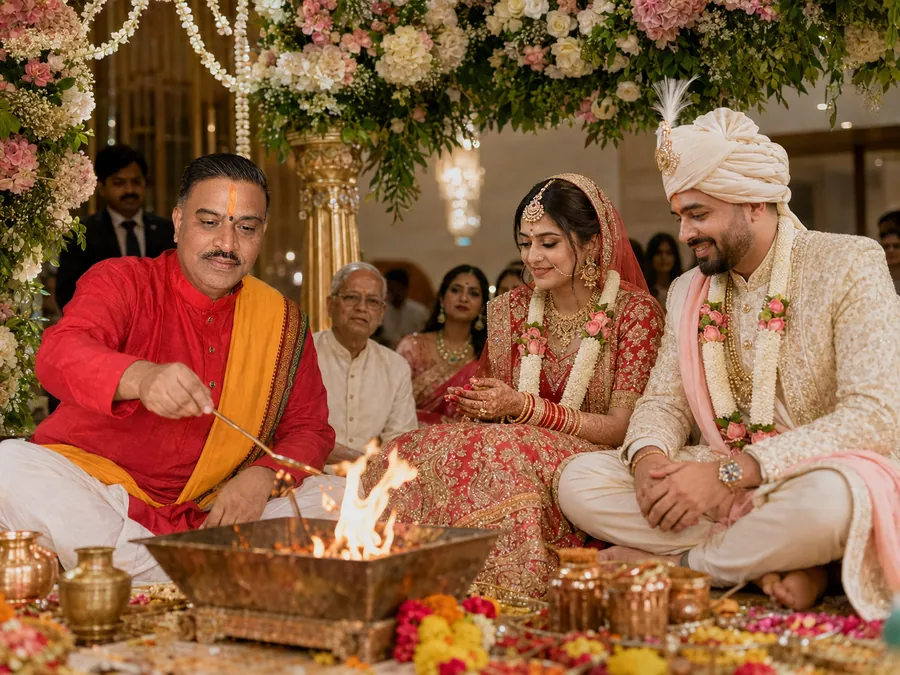
In Hindu tradition the fire, Agni, is the witness to the marriage, which is why it sits at the centre of the mandap. Treat the space immediately around it as the ceremony’s centre rather than as a set piece.
How should the team move around it?
Keep clear of the area between the couple and the fire, avoid stepping over or reaching across it, and agree crossing points and standing positions with the couple and priest before the ceremony begins.
Who decides whether a fire is permitted?
The venue, and the rules that apply to it. Confirm the venue’s position early and in writing where you can, so the ceremony can be planned around the actual answer.
What if an open flame is not allowed?
The ceremony is adapted respectfully rather than promised regardless. Knowing early gives the family time to consider the alternatives calmly with their priest.
The venue-facing questions are set out in Sacred Fire & Venue Planning. That page is ceremony-planning information, not fire-safety certification.
On the day
Sight-lines, movement and the timeline
Photography and the ceremony want the same outcome. A little agreement beforehand is what stops them competing.
Both families should be able to see the couple throughout. Agreeing where cameras, screens, cabling and any additional lighting sit — before guests are seated — protects the view for the people the ceremony belongs to.
During the quieter passages, movement close to the mandap draws attention away from the rites. Pre-agreed positions and appropriate lens choice can reduce unnecessary movement close to the mandap.
Entrances, seating and microphones benefit from a short walkthrough with the venue. Where a family has asked for English explanation during the ceremony, that needs to be audible too.
Why a pre-event conversation helps
A short conversation before the wedding lets everyone work from the same information: which rites are included, the agreed ceremony window, where the fire will be, which moments matter to the couple, and which passages should not be interrupted. It reduces the need to reconstruct those details on the morning.
If you are working on a wedding with us, get in touch with the couple’s permission and we will talk it through with you.
Questions
From planners, venues and photographers
Continue reading
- Hindu WeddingsThe ceremony journey, from proposed date to the sacred fire.
- Sacred Fire & Venue PlanningThe questions to raise with the venue, early and precisely.
- The Ceremony, Stage by StageA plain-English walkthrough of what happens, and where families differ.
- Destination Hindu WeddingsPlanning a Hindu ceremony abroad, from the UK.
- Trusted PartnersHow supplier recommendations are handled, transparently.
For the wedding team
Planning a Hindu wedding with us?
Tell us the wedding you are working on and what you need to confirm. With the couple’s permission we will go through the ceremony, the timings and the practical requirements with you.