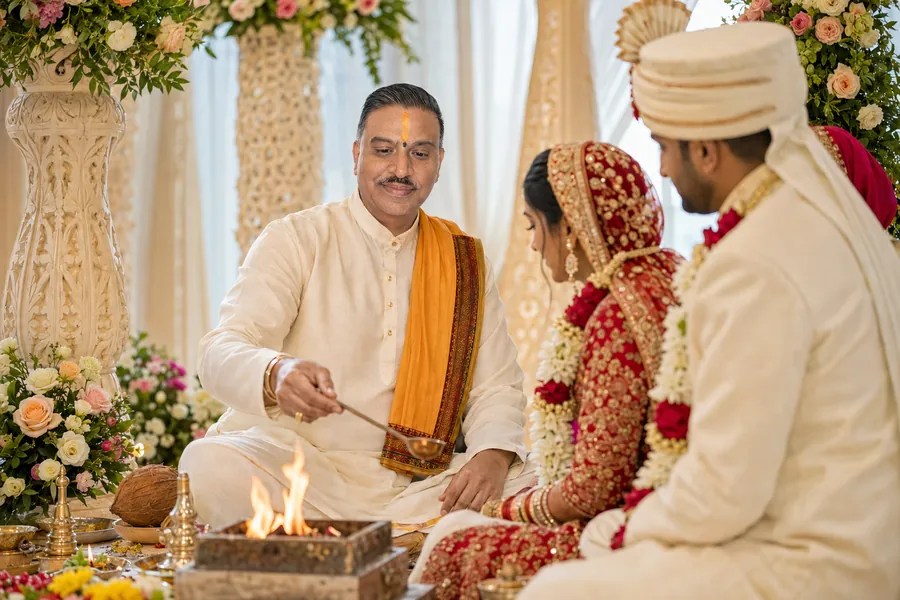
Gujarati weddings
Gujarati Hindu Wedding Priest
Mandavo, Grah Shanti, Randal Mata na Lota and the Gujarati Vivah Sanskar — performed in the vidhi your family and community keep, and explained in Gujarati or English so every guest understands what they are witnessing.
Quick answer
A Gujarati wedding, briefly
What is a Gujarati Hindu wedding?
The Vivah Sanskar as kept in Gujarati families — Ganesh Sthapana, the Mandavo, Grah Shanti and Randal Mata na Lota where observed, then Ponkhvu, Hasta Melap, Mangal Fera around the sacred fire and Saptapadi, closing with Kansar and Vidaai. Customs vary between families and communities, and yours are followed.
Who leads it?
Shastri Ji Manishbhai Pandya, who specialises in traditional Gujarati Vedic ceremonies and vidhi. Mantras are recited in Sanskrit, and Shastri Ji can communicate in English, Gujarati, Hindi and Punjabi. He is experienced in conducting and explaining ceremonies for families from North Indian and South Indian traditions.
In practice
The vidhi your family keeps, at a pace both families can follow
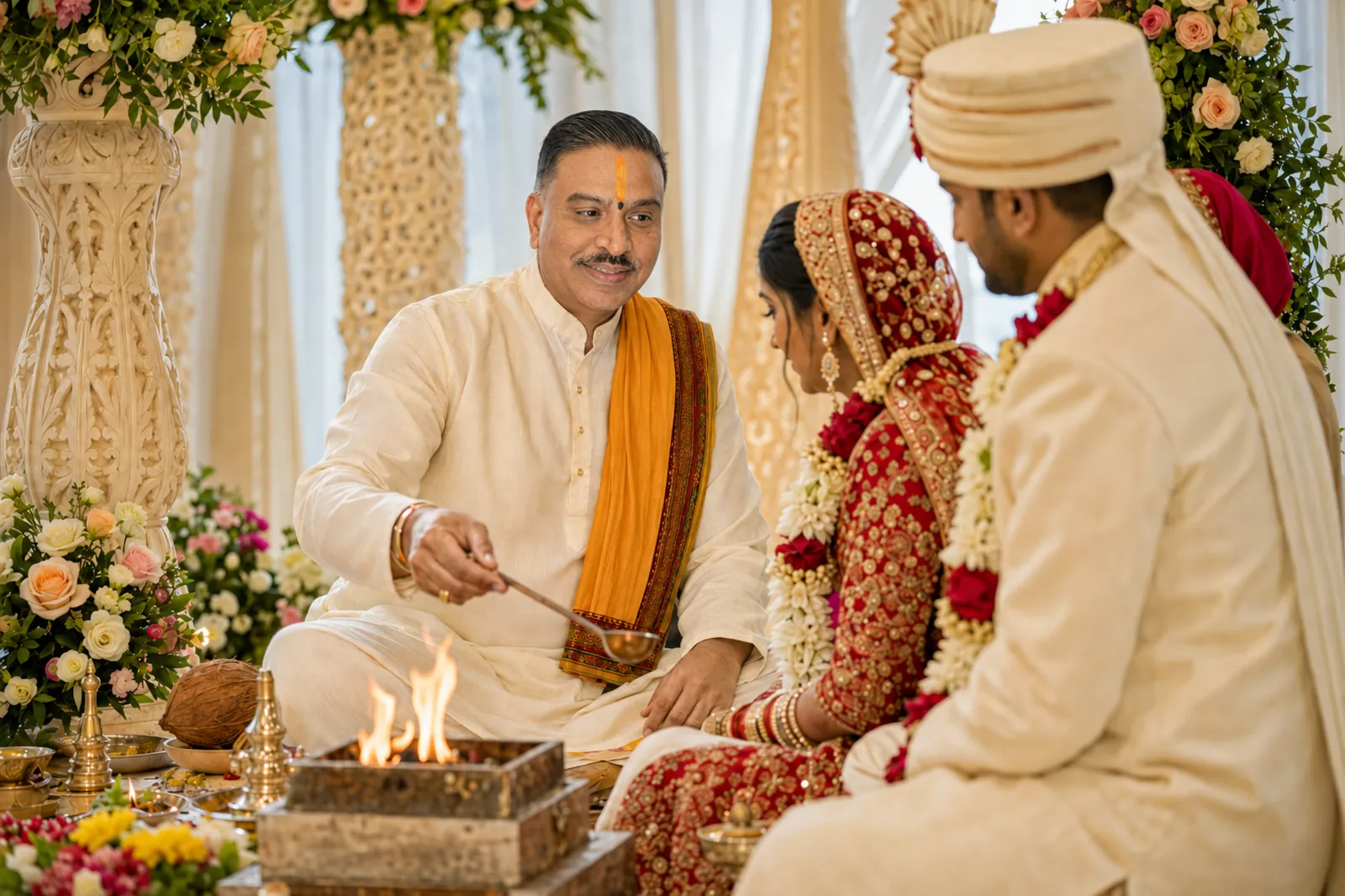
A Gujarati wedding gathers many small rites into one day — Ganesh Sthapana, Ponkhvu, Hasta Melap, the four Mangal Fera, Saptapadi, Kansar. Manishbhai leads each in the order your family and community keep, and pauses to explain in Gujarati or English where a guest might otherwise lose the thread.
Where the two families keep different customs, the differences are talked through beforehand rather than discovered at the mandap.
Why a Gujarati wedding is its own tradition
A Gujarati wedding is a Hindu Vivah Sanskar, but it is not interchangeable with a North Indian or South Indian one. The days before the wedding carry as much of the tradition as the mandap does: the Mandavo as the mandap is raised, Grah Shanti at each home, Randal Mata na Lota in families who keep the vow. On the day, the Ponkhvu, the antarpat, four fera rather than seven in most families and the Kansar afterwards are all Gujarati customs that a family recognises instantly — and that a priest from another tradition may not perform in the form your elders expect.
Manishbhai comes from a Brahmin family that has served as priests for generations and was trained in Gujarati Vedic ceremonies from childhood. He asks which vidhi your family keeps — Vaishnav, Swaminarayan, Shaiv, and the community customs of Patel, Lohana, Vanik and other families — and performs it that way, explaining each step to the guests who are new to it without shortening anything for their benefit.
For the wider wedding journey — venue, sacred fire, timings and how both families are prepared — see Hindu weddings. For a Gujarati wedding held abroad, see destination weddings.
Before the day
The household rites that come first
Presented as guidance rather than a fixed order of service. Which of these your family observes, and in what form, is agreed with you before anything is confirmed.
Ganesh Sthapana
Prayer to Lord Ganesha at each family’s home before the wedding rites begin, so that everything that follows starts in the traditional order.
Mandavo / Mandap Muhurat
The Mandavo ceremony, held by many Gujarati families in the days before the wedding as the mandap is raised — a household rite with the extended family present.
Grah Shanti
The Navagraha puja held at home for the wellbeing of the household before a marriage. Observed in many Gujarati families and not in others; yours decides.
Randal Mata na Lota
The Randal Mata vidhi kept by many Gujarati households around a wedding or a family vow, prepared in the form your own family observes.
On the day
From the Baraat to the Vidaai
The Gujarati Vivah Sanskar as most families keep it. Community variations are respected, and the sequence is explained as it happens.
Step 1: Baraat & Ponkhvu
The groom’s arrival and the welcome at the mandap by the bride’s mother — a Gujarati custom with its own gestures, explained for guests as it happens.
Step 2: Kanya Aagaman & Hasta Melap
The bride’s arrival and the joining of hands, with the antarpat lowered at the moment your family’s tradition holds.
Step 3: Mangal Fera & Saptapadi
The circuits of the sacred fire — four in most Gujarati families — and the seven steps, each explained briefly in Gujarati or English.
Step 4: Kansar, Aashirvaad & Vidaai
The sharing of sweetened food, the blessings of both families and the departure, held with dignity rather than hurried for a schedule.
Practicalities
Planning a Gujarati wedding in the UK
What should we check with the venue?
Whether a sacred fire is permitted indoors, how the mandap will be positioned, and the access and finish times. The sacred fire and venue guide sets out the questions to ask before the booking is final.
What samagri does a Gujarati wedding need?
The items for Ganesh Sthapana, the Mandavo and the mandap itself — kalash, coconut, rice, kumkum, the varmala and the materials for the havan — on an itemised list given to both families. The samagri can be arranged for you; costs are discussed once the ceremony requirements and location are understood.
Questions
Gujarati weddings
Continue reading
- Hindu weddings in the UKThe full wedding journey, from first conversation to the day itself.
- Grah Shanti — the Navagraha pujaWhat the pre-wedding household prayers involve.
- Legal marriage in England & WalesHow the religious ceremony and the register office fit together.
- Every ceremony, by occasionThe master directory of pujas, sanskaras, weddings and rites.
- Hasta Melap, explainedThe joining of hands and the muhurat.
- Mandavo & Mandap MuhuratThe household ceremony that opens the wedding.
- Randal Mata na LotaThe household vidhi, and how it is held in a UK home.
A personal invitation
Tell us about your wedding
Every family is different. Share a few details and we will talk through the ceremony, your customs and what is needed — before anything is confirmed.